Dr. Mukwege breaks the silence in Porto Alegre by FRONTEIRAS DO PENSAMENTO

Denis Mukwege and Marcos Rolim (clik on the picture above - part 1)
sábado, 14 de junho de 2025


terça-feira, 18 de agosto de 2015
sábado, 15 de agosto de 2015
segunda-feira, 25 de maio de 2015
| Conflitos armados contemporâneos na África negra e suas causas ambientais | |
| Autor | Lunardon, Jonas Araujo |
| Orientador | Vizentini, Paulo Gilberto Fagundes |
| Data | 2010 |
| Nível | Graduação |
| Instituição | Universidade Federal do Rio Grande do Sul. Faculdade de Ciências Econômicas. Curso de Relações Internacionais. |
Este trabalho tem como objetivo analisar os conflitos civis ocorridos na África Subsaariana após o término da Guerra Fria, em 1989. Através de uma interpretação empírica da conjuntura daqueles Estados e populações, esta monografia refuta a tese de que estes confrontos civis seriam “conflitos étnicos” fundados primordialmente nas diferenças e rivalidades culturais entre determinados grupos populacionais. A diferenciação étnica tem importante papel durante a dinâmica do conflito, pois, ao se sustentarem nas rivalidades identitárias, as lideranças conseguem mobilizar diretamente suas populações em direção ao combate. Esta, porém, não é causa fundamental destas disputas. Tendo como base a debilitada construção do sistema africano de países durante a colonização e o período de independências, é possível estabelecer motivações políticas, econômicas e sociais para a ocorrência da violência, que é ainda estimulada pela conjuntura estrutural ali encontrada. Elucidando as reais motivações para as guerras civis, introduz-se a análise das mudanças ambientais como agentes nestes conflitos. Devido à incapacidade de gerência dos governos e a fragilidade institucional daqueles Estados, as conseqüências das alterações no meio-ambiente – secas, escassez de terras férteis, desflorestamento, entre outros – somam-se ao rol de motivações para que guerras civis sejam deflagradas, minando um horizonte otimista de desenvolvimento da região.
Fonte: TEXTO PDF COMPLETO: http://www.lume.ufrgs.br/bitstream/handle/10183/28369/000770754.pdf?sequence=1
Communiqué de presse, 20 May 2015
Strasbourg, France - Déclaration du Docteur Denis Mukwege:
"Les élus du Parlement européen ont voté contre les minerais des conflits et pour les droits humains. Une importante contribution pour la PAIX."
"Le vote sur les minerais de conflit au Parlement européen, à Strasbourg, est une victoire pour les droits de l'homme. Qui témoigne que nous avons atteint un tournant décisif dans le dialogue. Cette réglementation oblige les raffineurs, les fondeurs, les fabricants et les importateurs des produits contenant l'étain, le tantale, le tungstène et l'or de s’assurer qu'ils s'approvisionnent de manière responsable, en amont comme en aval. Cette nouvelle réglementation démontre que qu’une gouverance économique éthique est non seulement possible, mais aussi requise.
"Une grande majorité de députés européens accorde la priorité au caractère global et au champs d'application large de cette réglementation. En effet, elle établit la position des élus et servira de base au cadre de négociations entre les Etats Membres et la Commission, et elle reflète le progrès au travers des lois contraignantes en RDC, dans plusieurs autres pays Africains et aux Etats Unis.
"Une industrie sans minerais de conflit contribuera à mettre un terme donc un terme aux violences effroyables que le peuple Congolais a enduré pendant des années. Les gouvernements ne doivent pas seulement élaborer des lois contraignantes, mais ils doivent aussi être prêts à les mettre en oeuvre. Et, les compagnies ont non seulement la responsabilité de conformité et de divulgation publique, mais aussi d'agir en toute transparence, à une époque où les consommateurs sont de plus en plus sensibilisés sur à la nécessité de ne pas acheter des produits lies aux conflits.
"Des dizaines de milliers de mineurs légitimes bénéficieraient de l'exploitation de minerais non-conflictuels et d'une industrie transparente. Les communautés et les familles déchirées par les conflits ont droit à une paix durable. À l'Hôpital de Panzi, nous avons à ce jour traité plus de 40 000 survivantes de violences sexuelles. Leurs corps ont été utilisés comme champs de bataille où subsistent des traumatismes physiques et psychologiques. L'exploitation des minerais est donc une des causes qui alimentent la souffrance au Congo.
"Aujourd'hui, le Parlement Européen a pris une position forte. Et j'espère que tous les Etats Membres vont aussi consolider leur engagement. Ce conflit a déjà engendré trop de pertes en vies humaines et une dégradation des conditions de vie pour les communautés locales. Nous devons donc agir ensemble pour apporter la paix et la transparence dans l'exploitation et le commerce de minerais."
Fonte: http://www.panzifoundation.org/news/
Denis Mukwege: winner of Sakharov Prize 2014
Article - Human rights − 21-10-2014 - 19:14 Denis Mukwege ©BELGA_ANP COMM_SVEN TORFINN
Denis Mukwege is the laureate of the Sakharov Prize for Freedom of Thought 2014, following today's decision by EP President Martin Schulz and the political group leaders. Mukwege will be invited to Strasbourg on 26 November to receive the award during the plenary session.
Announcing Mukwege as the 2014 laureate, President Schulz said: "The Conference of Presidents decided unanimously to award Dr Denis Mukwege from Democratic Republic of Congo the Sakharov Prize for his fight for protection especially of women.However, the political groups recognise the important role played by EuroMaidan in Ukraine and thus want to invite its representatives to join the award ceremony in November," adding
that it was also decided to send a delegation with representatives from all political groups to Azerbaijan to meet and support Leyla Yunus in her fight for democracy and freedom in her country.
The gynaecologist standing up for women´s rights
In many armed conflicts around the world, rape is used as a weapon of war, but Mukwege decided to help victims in his country. The 59-year-old gynaecologist founded the Panzi Hospital in Bukavu in 1998, when a war took place in the Democratic Republic of Congo, where today he still treats victims of sexual violence who have sustained serious injuries.
The war in DRC might be officially over, but the armed conflict still continues in the eastern part of the country and so do attacks against civilians, including gang rapes. Despite travelling regularly abroad to advocate women’s rights and managing Panzi Hospital, Mukwege continues to see patients and perform surgery two days a week. He was nominated by the S&D and ALDE groups and MEP Barbara Lochbihler.
Sakharov Prize
The Sakharov Prize for Freedom of Thought is awarded each year by the European Parliament. It was set up in 1988 to honour individuals and organisations defending human rights and fundamental freedoms. Last year the prize was awarded to Malala Yousafzaï, the Pakistani campaigner for girls' education.
Supporting human rights
The European Parliament takes all human rights violations seriously, no matter where they take place. MEPs regularly highlight abuses, help monitor elections around the world, ensure that human rights are protected in the EU's external economic and trade agreements, and award the Sakharov Prize for Freedom of Thought every year.
REF. : 20141016STO74202
Updated: 06-11-2014 - 11:30
Fonte: http://www.europarl.europa.eu/news/en/news-room/content/20141016STO74202/html/Denis-Mukwege-winner-of-Sakharov-Prize-2014
quinta-feira, 11 de setembro de 2014
segunda-feira, 1 de setembro de 2014

Denis Mukwege (2013, Democratic Republic of Congo)

Denis Mukwege (Democratic Republic of Congo)
“...for his courageous work healing women survivors of war-time sexual violence and speaking up about its root causes”.
Dr. Denis Mukwege is a gynaecologist working in the war-torn region of Kivu in the Democratic Republic of Congo (DRC). As the chief surgeon of Panzi hospital, he and his colleagues have treated about 40,000 rape victims, developing great expertise in the treatment of serious gynaecological injuries. Despite attacks on his life, Denis Mukwege speaks up tirelessly to raise awareness about the realities of the Congolese war and its grave, lasting consequences for girls and women.
Education
Denis Mukwege was born on 1 March 1955 in what is today the Democratic Republic of Congo (DRC). He studied medicine in Burundi and started practicing at the Christian Hospital at Lemera in South Kivu in the Eastern DRC. Shocked by the appalling difficulties of Congolese women in childbirth, he decided to specialise in obstetrics and gynaecology. After completing his studies in France, he returned to South Kivu in 1989.
The Panzi Hospital
In 1996 the hospital at Lemera was completely destroyed in the civil war. With the help of international aid organisations, Dr. Mukwege then founded the Panzi Hospital in the Panzi neighbourhood of Bukavu and became its manager and chief surgeon. Today, the hospital has four departments: obstetrics and gynaecology, paediatrics, surgery, and internal medicine. Panzi Hospital has been serving as a university hospital for the Université Evangelique d´Afrique which started its operations near the hospital in 2011.
The Panzi hospital is best known for its gynaecological skills, including fistula repair. Mukwege is training staff to help with these complications, in collaboration with, among others, the Fistula Hospital in Addis Ababa (founded by Catherine Hamlin, Right Livelihood Award 2009) and Harvard Medical School.
From 1999 on, Dr. Mukwege began to see a new level of extremely cruel sexualised violence in the Eastern DRC. He began seeing patients whose entire vagina and rectum had been destroyed with knives or other objects. Since then, Dr. Mukwege and his team at Panzi hospital have treated around 40,000 victims of sexual violence. Dr. Mukwege himself sees 20 patients each day, of which 7-10 suffer from health issues and injuries due to sexual violence. Compared to other conditions treated at the hospital, these cause the biggest psychological and surgical challenges. Dr. Mukwege has reported that it happens that a woman he has treated successfully is raped again and comes back to the hospital, with no more chance for the surgeon to repair her reproductive organs once again.
Dr. Mukwege says: “The perpetrators of these crimes destroy life at its entry point. The women can no longer have children. Often they get infected with AIDS and will spread the disease. Their men are humiliated. So the perpetrators destroy the entire social fabric of their enemies, their communities, their future generations, without even killing the woman. A line has been crossed here, which should have been an absolute taboo. But because those parts of the body are not usually visible, it is not as obvious as other forms of mutilation.”
A big problem in the DRC is that perpetrators enjoy a large degree of impunity, even if they can be identified.
In 2013, Panzi hospital had 398 employees and an annual budget of USD 3.2 million. The hospital has 450 beds, of which 250 are reserved for victims of sexual violence. Patients who cannot afford the care are treated free of charge.
Reintegration and support
Besides medical support, Panzi tries to provide its patients psychological counselling, legal advice, and a perspective for those who cannot go back to their former lives. This work includes DORCAS in Bukavu, a mother-child compound for women who have been released from the hospital and are coached to start an existence with microfinance help.
In addition, Mukwege has set up the Panzi Foundation. It has two full-time employees working out of the Panzi hospital premises, two lawyers and eight volunteer lawyers. The foundation provides assistance and legal clinics for victims of sexual violence around a number of legal topics (heritage, family law, divorce, adoption), psychological counselling, trainings in women’s rights and family living, work against early marriage, health advice workshops, and trainings for community leaders.
Urging the international community to bring an end to the conflict in Eastern DRC
Recognizing that his medical work treats the victims but cannot prevent new violence, Dr. Mukwege has been traveling the world and giving countless interviews to alert the international community about the horrors of the conflict in Eastern DRC.
He says: “In reality, this conflict is not about ethnicity, but it is a territorial conflict about mineral resources. The region of Kivu is rich in coltan, which is needed for mobile phones and laptops. Without the political will the situation will not change. These underlying problems cannot be solved through my work.”
Dr. Mukwege says that the DRC needs a professional, predominantly female police force and an army that protects its people and that excludes those who have destroyed the country. Mukwege is afraid that if the international peacekeepers leave the country before a functional army and police have been established, there will be chaos. He also demands an international criminal tribunal for the DRC like those for Sierra Leone and Yugoslavia.
In a speech at the UN on 25 September 2012, Mukwege called for the UN’s “unanimous condemnation of the rebel groups who are responsible for these acts [of sexualised violence]” and for “concrete actions with regard to member states of the United Nations who support these barbarities from near or afar”. He said: “We do not need more proof, we need action, urgent action to arrest those responsible for these crimes against humanity and to bring them to justice. Justice is not negotiable.”
Assassination attempt and current situation
One month after Mukwege’s speech at the UN, five armed men in civilian clothes slipped into his house in Bukavu while he was away. When he returned in his vehicle, they attacked him, but one of his staff, Joseph Bizimana, distracted the murderers and was killed by them. He saved Mukwege’s life. The local authorities claim they found the murderers, but no trial was held, and none of the witnesses were called to testify. Mukwege decided to escape to Europe with his wife and two daughters.
In his absence, local women’s groups protested against the attack to the authorities, started to collect money for a flight ticket for Mukwege to come home, and promised him they would ensure his security by taking turns to guard him, with groups of 20 women volunteering in shifts around the clock. Moved by their courage and support, Mukwege returned to Bukavu in January 2013. Driving from the airport to the hospital, he was met by cheering crowds. He now lives and works day and night at the Panzi Hospital, continuously accompanied by two bodyguards.
In May 2013, the Panzi Hospital reported that now even small children are becoming victims of sexualised violence: when nine girls not older than five years, were brutally raped in South Kivu, two of them died of their injuries and the others were treated at Panzi hospital for their severe complications.
Honours
Among the many awards bestowed upon Dr. Mukwege are the UN Human Rights prize (2008), the Olof Palme Prize (2009) and the King Baudouin International Development Prize (2011). In 2009, the Nigerian newspaper Daily Trust named him “African of the Year”. He is also recipient of the 2013 Human Rights First Award.
sábado, 13 de julho de 2013

Carlos Alexandre Netto - Denis Mukwege- Milton Paulo de Oliveira
Dr. Denis Mukwege, ao lado do Reitor da UFRGS em Porto Alegre,, representa a personificação do médico ideal: humano , corajoso e competente. Quanto a mim, cabe-me a honra de tê-lo como amigo.
Hosítal de Panzi no Congo: https://twitter.com/docmilton/status/356180172464074752
terça-feira, 8 de janeiro de 2013
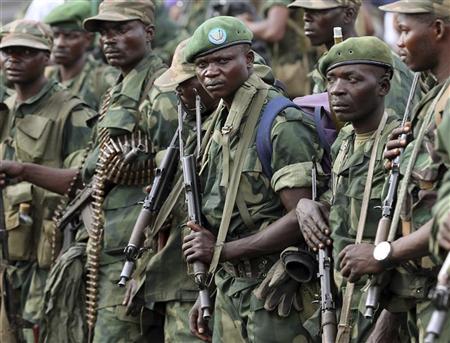
Reuters/Reuters - Government army FARDC soldiers stand in a line in an army barrack as they return to Goma December 3, 2012. REUTERS/Goran Tomasevic
Por
LUCIANA MARTINEZ
RIO - Uma das maiores cidades da República Democrática do Congo, na África, foi tomada por rebeldes no último dia 20 de novembro, em uma guerra que pode redefinir a região, mas tem pouca atenção da comunidade internacional. Dias depois de tomar Goma, capital de Kivu do Norte, membros da milícia M23 permitiram a volta de autoridades congolesas, mas o clima na cidade ainda é de medo e tensão (os rebeldes estariam ainda a menos de 2 quilômetros da região). O governo acusa Ruanda, a menina dos olhos de ouro do Ocidente na África, de inflamar o conflito, e analistas da ONU denunciam a participação do presidente ruandês, Paul Kagame, na desestabilização do leste do Congo, região rica em minérios.
Para analistas, o apoio de Ruanda ao M23 tem raízes históricas e econômicas. A região do Kivu é rica em minérios e, há anos, Kigali se aproveita ilegalmente dos recursos do país vizinho. Estima-se que o governo ruandês tenha ganhado milhões de dólares apoiando movimentos rebeldes congoleses que controlam minas no país e contrabandeiam minérios para Ruanda, que os exporta para o resto do mundo. Além disso, os rebeldes do M23 são em grande maioria tutsi, mesma etnia dos que hoje governam Ruanda e que nos anos 90 foram massacrados pelos hutus.O Movimento 23 de Março, conhecido como M23, é formado por uma milícia que conta com antigos membros do Congresso Nacional pela Defesa do Povo (CNDP), um movimento armado fundado pelo general tutsi Laurent Nkunda. Eles acusam o governo de não cumprir o acordo de paz de 2009, mas não especificam termos para negociar com o presidente Joseph Kabila e desde abril passado lançam uma ofensiva contra o leste do país. Nkunda e a milícia M23 são acusados de uma série de graves violações de direitos humanos, como estupros em massa e o recrutamento de meninos-soldados.
- Sendo largamente de etnia tutsi, esse movimento recebe forte apoio logístico, financeiro e de armamento diretamente de Ruanda; acredita-se que a cadeia de comando vá até o próprio ministro de defesa em Kigali - explica o professor de Relações Internacionais da PUC-Rio Kai Michael Kenkel, acrescentando que Uganda também envia ajuda ao M23. - O M23 enfrenta regularmente as Forças Democráticas para Libertação de Ruanda (FDLR), organização hutu herdeira dos perpetradores do genocídio em Ruanda.
Apesar das denúncias do governo do Congo e da própria ONU, Ruanda nega envolvimento com o M23, mas não esconde simpatias pelo movimento. A chanceler ruandesa, Louise Mushikiwabo, por exemplo, disse em meados de 2012 que seu país deveria exercer algum tipo de controle no leste do Congo, já que historicamente o território pertenceria a Kigali. O presidente Paul Kagame, por sua vez, se recusa a condenar os rebeldes, ignorando a pressão internacional.
A menina dos olhos de ouro do Ocidente
Desde o genocídio de tutsis, em 1994, a comunidade internacional defende Ruanda, negando os relatos de influência no conflito no Congo. A cada ano, Kigali recebe cerca de US$ 1 bilhão de ajuda internacional, o equivalente a quase metade de seu orçamento anual. Em julho, vários governos ocidentais suspenderam o envio de verbas para Ruanda, após relatos de que o país estaria armando os rebeldes no Congo, mas muitas instituições internacionais, como o Banco Mundial, continuam a dar empréstimos para o governo de Kagame.
- Apesar de vários governos ocidentais condenarem fortemente o apoio da Ruanda ao M23, o governo americano hesitou em fazer o mesmo e só nesta semana condenou o movimento. Alguns estimam que a força motriz desse apoio (Ruanda) seja um sentimento de culpa para com os tutsi, atualmente no poder, depois de terem se recusado a agir para pôr fim ao genocídio contra esse povo em 1994 - explicou o professor Kenkel. - Além disso, Washington confia na pessoa de Kagame para manter o difícil equilíbrio no país e prefere o diálogo construtivo a uma condenação pública pela ONU.
Alguns países dizem que pressionar Ruanda poderia gerar ainda mais instabilidade na região, um argumento que parece ignorar o papel de Kigali na desestabilização do Congo. Em artigo para a “Foreign Policy”, o jornalista indiano Anjan Sundaram, autor do livro “Stringer: a reporter's journey in the Congo” (que será lançado no ano que vem), acusou organizações de ajuda humanitária de ter medo de perder o que consideram um modelo de desenvolvimento na África: desde 1994, Ruanda vem apresentando constante crescimento econômico.
A retomada do conflito em abril passado pôs fim aos poucos anos de gradual progresso no leste do Congo, onde algumas regiões perto de Goma tinham sido estabilizadas, pela primeira vez desde 1996. No último dia 15, o presidente congolês, Joseph Kabila, prometeu uma iniciativa para unir o país.
Hoje, rebeldes e representantes congoleses tentam negociar uma saída para o conflito em Uganda. Kabila afirma que o diálogo deve “estabelecer e esclarecer responsabilidades”, mas não deu detalhes sobre o andamento das negociações e é difícil de se imaginar um fim pacífico para o conflito. Enquanto isso, quem mais sofre é a população.
- Minha família e eu estamos cansados de guerra. Vimos exércitos do governo e de diferentes grupos rebeldes, agora isto (o M23 em Goma). Não temos escolha. É um problema de liderança - disse um morador de Goma, de 50 anos, ao portal Irin, logo após a invasão de novembro.
Fonte: http://oglobo.globo.com/mundo/congo-guerra-que-voce-nao-ouviu-falar-em-2012-7144152
REUTERS )
Publicado:

CAMPALA - Chefes de Estado da África pediram, neste sábado (24), aos rebeldes da República Democrática do Congo que parem a guerra e deixem a cidade de Goma, tomada pelo grupo nesta semana.
Os líderes se encontraram na capital de Uganda, Campala, para tentar encerrar o conflito, depois que rebeldes do M23 disseram que planejavam “libertar” o grande país do centro africano. O M23 teria o apoio de Ruanda, mas o país nega.
O comunicado dos presidentes pede que o M23 pare de falar em derrubar o governo eleito e “interrompa todas as atividades de guerra e deixe Goma”. Jean-Marie Runiga, chefe político do M23, que tomou a cidade de Goma nesta semana, também estava em Campala, mas não disponível para comentar o assunto.
A nota ainda afirma que os rebeldes devem retirar suas forças a pelo menos 20 quilômetros (12 milhas) ao norte de Goma e que a missão da ONU para a República Democrática do Congo, a MONUSCO, deve vigiar a zona.
A declaração também pede que governo congolês ouça e resolva as queixas dos rebeldes.
Não está claro se Runiga se encontrará com o presidente do Congo, Joseph Kabila. Kabila e os presidentes da Tanzânia, Yoweri Museveni, e o do Quênia, Mwai Kibaki, participaram do encontro. O de Ruanda, Paul Kagame, não participou, mas a ministra das Relações Exteriores, Louise Mushikiwabo, representou o chefe de Estado.
Os líderes resolveram implantar uma força da ONU em Goma, para ocupar e dar segurança à zona neutra entre Goma e as regiões tomadas pelo M23.
Goma é sede de uma força da ONU que tem o objetivo de ajudar as tropas do governo a proteger civis. O comunicado também disse que a polícia foi desarmada em Goma pelo M23, e que deve ser rearmada para continuar trabalhando.
Os rebeldes, porém, não deram sinal de que estão dispostos a atender os pedidos dos chefes de Estado. Segundo o jornal "The New York Times", neste sábado, o exército rebelde continuou a avançar no território do governo do Congo, enviando tropas para cercarem a pequena cidade de Minova, um trampolim para o próximo grande prêmio, Bukavu, uma das maiores cidades do leste do Congo.
Confrontos poderm acontecer a qualquer momento, disseram os rebeldes na noite deste sábado, já que as posições rebeldes e do governo estão a poucos quilômetros de distância.
"Por que deveríamos negociar com o governo?", Disse Bertrand Bisimwa, um porta-voz do grupo M23. "Eles estão falando de paz, mas mostrando-nos a mão da guerra".
Os desafios dos rebeldes em Goma
Horas antes de rebeldes tomarem a cidade de Goma, no leste do Congo, na última terça-feira (20), mais de mil prisioneiros abriram um buraco no muro da prisão e fugiram.
“Isso terá um grande impacto na segurança da cidade”, disse um magistrado local que não quis se identificar à agência de notícias Reuters.
Segundo o veículo de imprensa, a fuga em massa de presos é um exemplo dos desafios que o movimento rebelde M23 enfrenta, agora, para manter e administrar Goma e o território que ocupou em uma região muito disputada por suas riquezas minerais.
Os insurgentes do M23 tomaram a cidade depois que forças do governo abandonaram suas posições. Tropas de paz da ONU disseram que não poderiam defender a cidade, argumentando que tinham um mandado limitado. Mas os rebeldes precisam de segurança e de uma administração funcional se querem ganhar apoio.
Em um sinal de que os nervos ainda estão tensos, tiros no meio da tarde, nesta semana, fizeram com que os moradores corressem em busca de abrigo nas ruas enlameadas da cidade.
“Normalmente, essa estrada é congestionada, não dá para se mover. Mas olhe para ela hoje”, disse Georgette Bithondo, que vendia gasolina em garrafas plásticas. “Estamos sofrendo, estamos assustados”, acrescentou.
Atrás dela, carregadores sentavam-se ociosos em seus carrinhos de madeira. Bancos e várias lojas permaneceram fechados, quatro dias depois da entrada dos rebeldes.
Os preços dos alimentos estão subindo também. Uma medida de feijão, um alimento básico, agora, custa mil francos congoleses (US$ 1,07). Há uma semana, custava 800 francos. Enquanto isso, a farinha está 50% mais cara, a 500 francos uma medida nos mercados - tudo isso em um país onde 80% da população vive com menos de um dólar por dia.
Fonte: http://oglobo.globo.com/mundo/lideres-africanos-pedem-que-rebeldes-acabem-com-guerra-no-congo-6822814
quarta-feira, 7 de novembro de 2012


Dr. Mukwege Fights Back
02 de novembro de 2012

Nicholas D. Kristof/The New York TimesDr. Denis Mukwege at the Panzi Hospital in the Congo.
For the past 16 years at the Panzi Hospital in the Democratic Republic of Congo, my staff and I have been treating women who have been victimized by sexual violence, which has been systematically used as a weapon of war in the armed conflict that has ravaged our country. Rape is one of the most deadly weapons of war, destroying families and communities and future generations, as well as the women brutally targeted. Last year I had some hope that the situation was improving, but since the beginning of this year the security situation has again deteriorated and victims of sexual violence have started coming to the hospital again in greater numbers.
In our hospital near Bukavu, we have been helping women not only with medical treatment but also with psychological counseling, legal representation and financial support. We work to address all the consequences of the sexual violence they have suffered, but none of the causes of this violence which bring the women back to the hospital again and again. So now I am trying to use my voice, domestically and internationally, to address the causes of this violence and to call for peace and justice. I have attended many conferences in Europe and the United States on sexual violence in armed conflict and specifically on the situation in Eastern Congo.
A few weeks ago, I was attacked and almost killed in my home, which is in one of the most guarded and secure areas of Bukavu. I had gone to accompany a patient who had come to see me for medical advice, and when I returned I was met by heavily armed men who forced me out of my car. They had been in my house and forced my children onto the sofa at gunpoint, which is how I saw them when I arrived. I found myself with a gun to my head, and just as the gun was loaded and ready to shoot, a member of my staff heroically intervened to save me. He shouted and came running to jump on this armed intruder, who turned and shot him. He fell down, I fell down, and I can’t really remember what happened after that. I realized he was shot, and I saw him give his life for me. The attackers then got in the car and left.
Neither I nor anyone in my family have been questioned about this incident in an effort to find out who is responsible. The lack of investigation is symptomatic of the indifference that prevails in my country. After this attack many people have demanded the assurance of my security – this has been very helpful to me, but my security is not the real issue. It is not enough to assure my security, if even that can be done, when women are being violated with impunity on a daily basis.
Neither I nor anyone in my family have been questioned about this incident in an effort to find out who is responsible. The lack of investigation is symptomatic of the indifference that prevails in my country. After this attack many people have demanded the assurance of my security – this has been very helpful to me, but my security is not the real issue. It is not enough to assure my security, if even that can be done, when women are being violated with impunity on a daily basis.
For 16 years, these women have come to the hospital time after time, and each time, following medical treatment, I have urged them to go back to their villages. But after what has happened to me, I have a new understanding. I have seen what has been done to them. I have heard them tell me that armed attackers raped them and killed their husband, raped them and killed their children. I now understand this in a different way and my thoughts are with the women of my country who have suffered so much.
We talk about them as numbers and we don’t fully appreciate that they are individual human beings who have each been through a horrifying and destructive experience. Every one of these women should have the attention of the international community that I have received. The violations continue because of indifference on the part of our government and inaction by the international community – this happened to someone else. But really, it happened to one of us. We all belong to the same family of human society.
In the Congo, we have tried to make peace and we have sacrificed justice for the sake of peace. But today we have neither peace nor justice. And the problem is that the present Congolese army has been put together by the integration of former armed rebels who are responsible for rape and pillage. Perpetrators have been given the job of protecting their victims – it is a death sentence. It cannot work and we need international support to help our country make the security system function.
The dedicated and courageous staff who work at Panzi Hospital are scared, and my thoughts are with them. I want them to respond to this hatred with love because I think that it is the only way we can make a difference. If they continue to do what they do with love and care I have to believe that peace and justice will prevail. Violence can only create violence.
I believe that together we can conquer this hatred and we can help the Congo end the long standing armed conflict that has caused so much suffering and so much destruction. This is an easy problem to solve. It is fundamentally a question of political will, not only at the Congolese level but at the regional level and the international level. At the international level there is much talk of the conflict as a problem, and one United Nations report after another has clearly stated the problem. With political will we can solve the problem but unfortunately this political will is lacking.
We do not need more proof of what is happening, we need action to stop it, action to arrest those responsible for these crimes against humanity and to bring them to justice. We need unanimous condemnation of the rebel groups who are responsible for these acts, and we need concrete action with regard to member states of the United Nations who support these barbarities from near or afar. All the elements are there to put an end to an unjust war that has used violence against women and rape as a strategy of war. Congolese women have a right to protection just as all the women on this planet. It is an honor for me to serve these courageous survivors, these women who resist, these women who despite all remain standing.
Denis Mukwege is the Medical Director at the Panzi Hospital in the Congo.
Comments [...]
- Milton Paulo de Oliveira
- Brasil - Porto Alegre
FLAG
Dear Mukwege, who writes here is your friend and colleague Milton Paulo de Oliveira. In your home in the Congo, where he suffered this terrible violence ,I was received by you and your wife on a Saturday morning, and in a way I will never forget. You're the kindest and most courageous person that I've met . We, in fighting for your cause, fighting for the dignity of all of us. The fact that local authorities are not investigating the attack shows us how far we are from a solution to the Congo. is a very difficult battle, but not impossible. Be assured that we your friends in Brazil will continue to multiply that voice with so much effort you have brought to our country. I regret the loss of life in this attack and hope you and your family find the strength to continue. Before arriving in Brazil in 2010, I wrote about our meeting in Congo and the title of my article was: A Quixote in the Heart of Africa. The more time passes, the more I see that Don Quixote. However, I see not only in Africa. Now I see that noble knigh in the centter of your heart. Your forever friend, Milton Paulo.
Assinar:
Postagens (Atom)
THE ZOMBIE

By Milton Paulo de Oliveira
Documentary on The Congo: BBC's An African Journey
